It is a great coincidence that this week’s Vivero training is on textual analysis– this is what we’ve been pursuing for the past three days in my ENG 240 Digital Methods in English course, with Erik Simpson. Last class, we had learned about Voyant, another similar tool that offers a vast range of textual analysis and word counting tools.
Textual analysis has many applications. I’m speaking in terms of computational textual analysis, rather than the traditional definition of “close reading” that you find in most English classes. Computational text analysis allows you to generate a new lens on your text that is often unachievable without the help of a computer. By tallying frequencies of words, phrases (n-grams as we call them), and other things like punctuation, digital humanists can make connections between texts and authors. In ENG 240, our class textbook, Nabokov’s Favorite Word is Mauve, applies these methods to reveal how statistical counting of words can tell us a ton about a text and the author’s intentions. You can even do things like find an ‘authorial fingerprint’ for a text. (See this article from the University of Chicago for a brief intro to this idea of Text as Data.)
In class, we had used a mix of Voyant and Professor Erik Simpson’s own Python code that he created. It appears that the Gale Digital Scholars Lab is fairly similar. It offers an accessible way to do humanities computing, especially for students from a non-technical background.
For the training document questions, I’d say that learning this tool was a touch more complicated than Voyant. Whereas Voyant seems to offer a (sometimes overwhelming) array of tools in its interactive dashboard, Gale Digital Scholars Lab functions in something like a library analysis tool. Gale offers a few guiding stages to your research project: Build, Clean, Analyze. The “Cleaning Stage” offers some useful presets and you can effectively clean the data without needing too much technical know-how.
Regardless, the interface isn’t quite as straightforward as Voyant. It feels dryer and again, more like a library research tool. I’d still see several use cases for it, depending on my research topic.
Ultimately, I am thankful to have been introduced to this field of computational humanities (also known as digital humanities, humanities computing, etc. etc.). It intersects my interest in statistics and programming with my interest in literature and the humanities quite nicely. It is worth additional exploration.
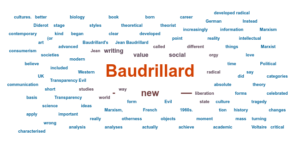
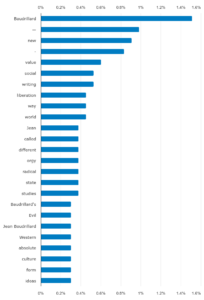
EDIT: I forgot to add what I actually analyzed in Gale Digital Scholars Lab! I selected three philosophy papers for my corpus of text, and then ran an n-grams term frequency and created a word cloud.
I chose three random papers on my favorite philosopher, Baudrillard, a French postmodernist. (Favorite as in I haven’t been exposed to many other philosophers, and so his ideas were my first taste of philosophy as a discipline). As can be expected, the almighty em-dash was the second most commonly used n-gram. Baudrillard was the most common, though I suspect the articles were commentaries about his work, so that makes sense.
Leave a Reply